
What Probate Covers in Gilpin County
Probate in Gilpin County is handled through the Probate Division of District Court at Gilpin Combined Court unless a particular matter belongs in another court by law. Colorado places probate in District Court outside Denver Probate Court, so local estate filings, will filings, letters, petitions, applications, claims, and closing documents route through the same Black Hawk courthouse used for other Gilpin District Court matters.
The local court contact is Gilpin Combined Court, 2960 Dory Hill Road, Suite 200, Black Hawk, CO 80422. The Colorado Judicial Branch lists the phone as 303-582-5522, fax as 720-894-8659, and email as GilpinClerksOffice@judicial.state.co.us. Clerk office hours are Monday through Friday, 9:00 a.m. to 4:00 p.m. In-person payment hours for collections are shorter, 9:00 a.m. to 3:30 p.m., so probate copy payments or case payments should be confirmed before visiting.
The Colorado Judicial Branch small-estate affidavit page is the official source for JDF 999, the personal-property collection affidavit used when an estate qualifies.
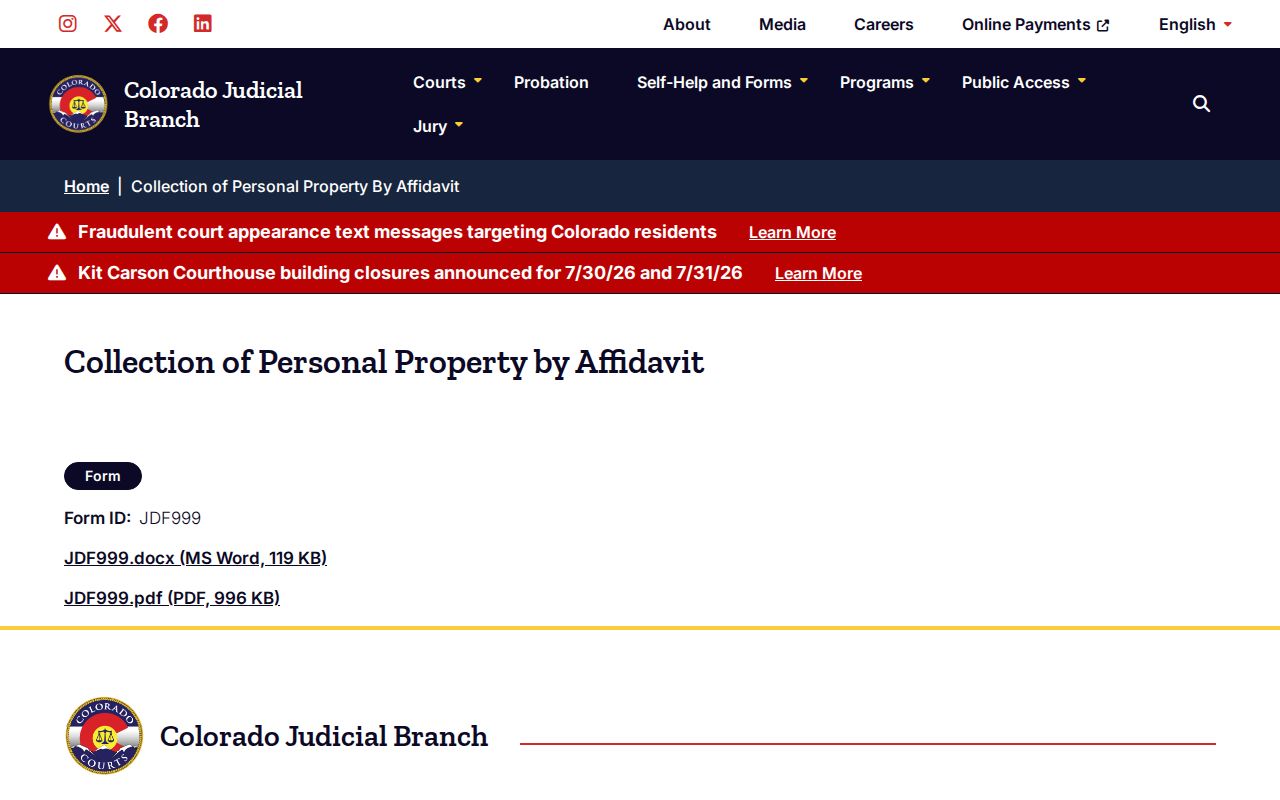
That affidavit path matters because some Gilpin County estate questions do not require opening a probate case, while court probate still goes through the District Court clerk.
Probate Terms Defined
Probate records use terms that describe the deceased person, the person managing the estate, the requested court authority, and the document type. These definitions are for reading records and request forms, not legal advice about what should be filed.
- Testator
- A person who made a will. A probate file may include the will and filings asking the court to recognize it.
- Personal representative
- The person appointed or authorized to collect assets, notify creditors, manage estate property, and distribute property. Colorado records may use this term instead of executor.
- Letters
- Court-issued authority showing the personal representative, guardian, or conservator can act. The record request form has a specific Probate checkbox for letters.
- Intestate
- Dying without a valid will. The estate may still require probate filings and court appointment of a personal representative.
- Guardianship
- A court matter involving authority over a person's care or decision-making. These files can include protected personal or medical information.
- Conservatorship
- A court matter involving authority over another person's money or property. Access may be limited because financial and identifying information can appear in the file.
- Claim
- A creditor or interested-party claim filed in an estate. The probate request form includes claims as a requestable document category.
How to Search Gilpin County Probate Division of District Court
Use the Colorado Judicial Branch docket search when the immediate question is whether a probate hearing is scheduled. A docket search is not the full case file and does not provide copies of wills, letters, petitions, or claims. For an estate hearing in Gilpin County, choose County = Gilpin County or Courthouse = Gilpin Combined Court, Court Type = District, and Case Class = PR. The docket form also requires a date range and at least one non-date filter.
- Open the Colorado Judicial Branch docket search and choose Gilpin County or Gilpin Combined Court.
- Select District as the court type because probate is handled in District Court for Gilpin County.
- Use Case Class = PR for probate if the form allows that filter, then add a date range such as Today, 1 Week, 1 Month, 3 Months, or a specific date.
- Search by case number if known; otherwise use party-name fields such as the decedent, personal representative, or interested party.
- Use the docket only for hearing and public case-event information, then request documents from the court if copies are needed.
For copies, use the statewide Colorado Judicial record/document request form. Choose Case Type = Probate, select Gilpin County as the county or location, provide the filing year if known, enter party names, and select the probate documents needed. The form's Probate section includes letters, will, trust, application, petition, closing, claims, and date of death. It also has a certified or exemplified option for official copies.
Probate Courts in Gilpin County
There is not a separate county probate courthouse for Gilpin County in the research. The probate court name resolved for this build is Probate Division of District Court, and the local filing and records destination is Gilpin Combined Court. Colorado's statewide court structure is important here: County Court and Black Hawk Municipal Court are not the ordinary estate-record custodians for wills, probate letters, or District Court probate files.
Probate Division of District Court
Gilpin Combined Court
2960 Dory Hill Road, Suite 200
Black Hawk, CO 80422
303-582-5522
Monday-Friday, 9:00 a.m. to 4:00 p.m.
Probate Filing Fees
The research located confirmed court copy and certification fees from the official Colorado Judicial record/document request form, but it did not locate a current Gilpin-specific filing-fee schedule for opening a new probate case. Use the court clerk or current Colorado Judicial fee schedules for new estate, guardianship, or conservatorship filing amounts. For record copies, the official request-form table applies.
| Item | Amount |
|---|---|
| New probate case filing | Confirm with Gilpin Combined Court or current Colorado Judicial fee schedule |
| Copy per page | $0.25 per page; party and attorney maximum may apply in their own case |
| Certified or exemplified copy | $20.00 per document |
| Name search | $5.00 |
| Off-site case file retrieval | Actual retrieval cost |
| Research or redaction | $30.00 per hour after the first hour, in 15-minute increments |
| Fee waiver note | Fees may be waived when required under CJD 06-01 or C.R.S. 13-32-104(1)(a) |
What Gilpin County Probate Records Show
A probate file can include applications, petitions, wills, orders, letters, creditor claims, inventories, accountings, closing statements, and related filings. The official request form does not require the requester to ask for the whole file; it gives targeted checkboxes for letters, will, trust, application, petition, closing, claims, and date of death. Targeted requests usually help the clerk identify the exact document and calculate copy or certification fees.
The probate document request fields are also useful when the case number is unknown. Provide the decedent's name, personal representative name, date of death if known, approximate filing year, and any other identifying details. The form includes filing-year options going back to 1873 and includes Gilpin County as a location choice. If a file is older or stored off site, the court may charge actual retrieval cost and may need more time than a simple current electronic record.
The U.S. Bankruptcy Court for the District of Colorado is a separate federal court and not the custodian of Gilpin County probate files.
Bankruptcy can involve estates and debts, but it is not the same as county probate; federal bankruptcy records use federal court systems, while Gilpin probate records remain District Court records.
Restricted Probate Division of District Court
Probate is not automatically a completely open file in every detail. The Colorado Judicial record request form warns that suppressed cases, juvenile and probate records, or documents containing confidential or protected information may require a U.S. government-issued photo ID. It also states that the Clerk of Court may restrict access under statutes, rules, Supreme Court rules, Chief Justice directives, local orders, and other legal authorities.
Common sensitive details in probate-adjacent files include dates of birth, addresses, financial account information, medical information, minor names, guardianship information, conservatorship accountings, and protected-party details. The clerk may redact those details, release only part of a filing, ask for proof of identity or relationship to the case, or deny access unless a court order or statute authorizes release. Adoption and mental health matters are especially restricted and should not be treated as ordinary public probate files.
Small-estate affidavits require separate care. JDF 999 is submitted under C.R.S. 15-12-1201 and is used for collection of qualifying personal property. The 2026 version requires at least ten days to have passed since death, no pending or granted application or petition for appointment of a personal representative in any jurisdiction, and personal property subject to succession at or below the year-of-death threshold after liens and encumbrances. The form is not valid for transfer of real estate. The listed thresholds are $88,000 for 2026, $86,000 for 2025, $82,000 for 2024, $80,000 for 2023, $74,000 for 2022, and $70,000 for 2021 and 2020.